Prop Firm Rules
The Consistency Rule, Explained: Why One Great Day Can Block Your Payout
Some links on this page are affiliate links. We may earn a commission if you sign up through them, at no extra cost to you.
A friend of mine passed his evaluation with a monster NFP trade — 60% of his whole profit target in one afternoon. The firm's response: nice trading, no payout yet. He hadn't broken a drawdown rule or the profit target. He'd broken the consistency rule, and he didn't know it existed. This article is so that never happens to you.
What is a consistency rule?
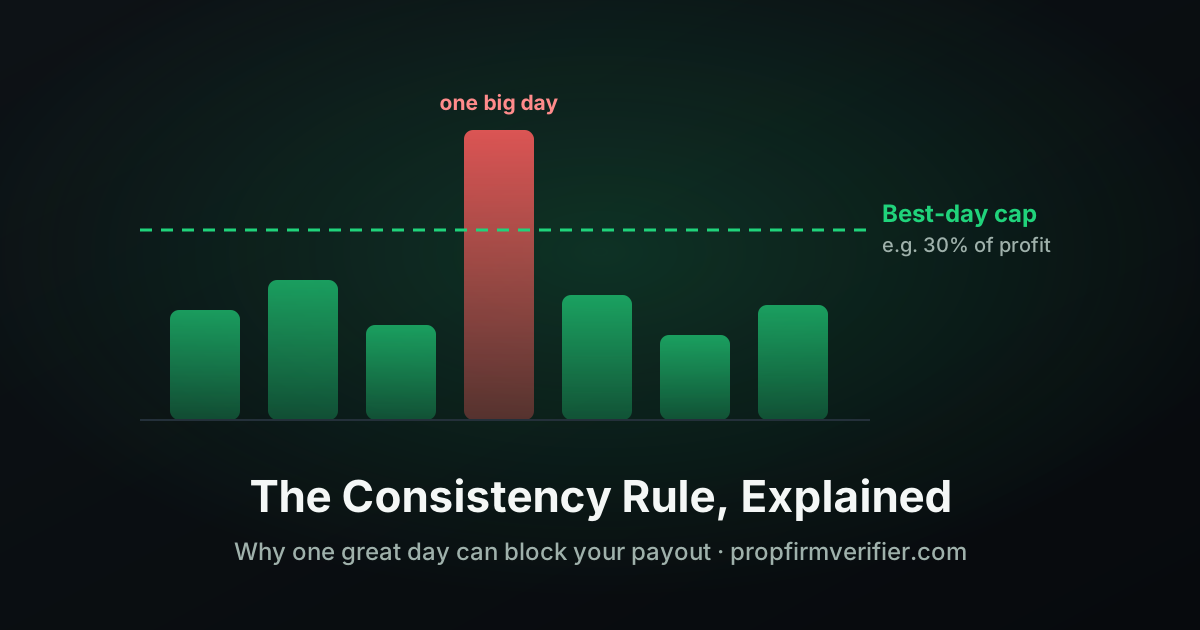
It's a percentage: your best day's profit divided by your total profit. If the rule is 30% and you made $2,000 total, no single day may account for more than $600 of it. The firm isn't judging whether you made money — it's judging whether you make money repeatedly, or got lucky once. From the firm's side it filters out gamblers; from your side it's a hidden second target you have to manage.
The math, with a worked example
Say your program has a 30% best-day rule and your profit target is $1,000:
- You make $700 on day one. Your best day is now 100% of your profit — massively over the cap.
- You can't just stop at the target. You need total profit high enough that $700 is under 30% of it: $700 ÷ 0.30 ≈ $2,333 total.
- So that one great day just tripled the profit you need before the account counts as passed or payable.
That's the trap: the rule punishes front-loaded profit. A big early win doesn't disqualify you, but it moves the finish line — and traders who don't know that keep "finishing" without being done.
Real consistency rules from firm rulebooks
These are current examples from our verified firm data (each link goes to the full review):
| Firm | Rule (paraphrased from the rulebook) |
|---|---|
| FTMO | 1-Step Standard: no single day may exceed 50% of total profit (evaluation and funded) |
| Blue Guardian | One day can't exceed 15–25% of total profit, depending on the program |
| Alpha Capital | On-demand 2% payouts require a 40% best-day rule plus 2% gross profit |
| For Traders | Best day under 15% (Instant) or 20% (Pay After Pass, funded) |
| Hantec Trader | 45% on EnhancedX, 20% on Instant Lite, 15% per-trade cap on Instant24 |
| Crypto Fund Trader | 40% rule on funded Break Program accounts |
Notice the spread: 15% is a genuinely demanding cap that forces many small days; 50% barely bites unless you pass in two trades. Same rule name, very different difficulty — which is exactly why "has a consistency rule: yes/no" isn't enough information when you're comparing firms.
Which prop firms have no consistency rule?
Plenty of respected firms skip the rule entirely on their standard evaluations and rely on drawdown limits alone. In our verified data, Alpha Futures, The Trading Pit, Blueberry Funded and Audacity Capital currently document no fixed consistency rule. If your edge is a few big days a month — news traders, breakout traders — that single line in the rulebook probably matters more to you than the price.
Sponsored
Trade big days without a best-day cap
Alpha Futures documents no fixed consistency rule on its evaluations — one strong session can simply count. Confirm the current rulebook on their site before buying, as rules do change.
See Alpha FuturesHow traders accidentally break it (and how not to)
- 1Not knowing the denominator. The percentage is measured against your *final* total profit, so you can trade your way back under the cap by adding more profitable days. Breaching it mid-challenge is rarely fatal — stopping there is.
- 2One oversized position. Some firms (like Hantec's Instant24) cap the best *trade*, not the best day. Splitting one idea into two entries doesn't change your risk but can keep each trade under the cap.
- 3Passing too fast. On a 15–20% rule you mathematically need at least 5–7 profitable days. Sprinting the target in two days just means trading longer afterwards.
- 4Confusing it with drawdown. The consistency rule manages your *upside* distribution. Your downside is still governed by the drawdown rules — we break those down in does trailing drawdown ever go away.
Final thoughts
The consistency rule isn't malicious — it's the firm asking for proof that your profit is a process, not an event. But it's the one rule that punishes you for doing *well*, so it deserves a spot in your pre-purchase checklist right next to drawdown type. You can filter and compare firm rules side by side in our prop firm comparison, where every review lists the consistency rule — or its absence — in plain language.
Frequently asked questions
What is a consistency rule at a prop firm?
A cap on how much of your total profit may come from a single trading day (or single trade), typically 15–50% depending on the firm. It's meant to prove your results are repeatable rather than one lucky trade.
What happens if I break the consistency rule?
Usually nothing fatal — the firm delays your pass or payout until your best day falls back under the cap as your total profit grows. You keep trading and add profitable days; stopping right after a big day is what actually gets traders stuck.
How do I calculate the consistency rule?
Divide your best day's profit by your total profit. To find the total you need after a big day, divide the big day by the rule percentage: a $700 day under a 30% rule requires about $2,333 in total profit.
Which prop firms have no consistency rule?
In our verified data, Alpha Futures, The Trading Pit, Blueberry Funded and Audacity Capital currently document no fixed consistency rule on standard evaluations. Always confirm the current rulebook before buying — firms update rules.
Is the consistency rule bad for news traders?
It's the single most important rule to check. News and breakout strategies concentrate profit into few big days, which is exactly what a 15–25% cap punishes. Pick a firm with a loose cap (40–50%) or none at all.
Keep reading
Risk note