CFD vs Futures
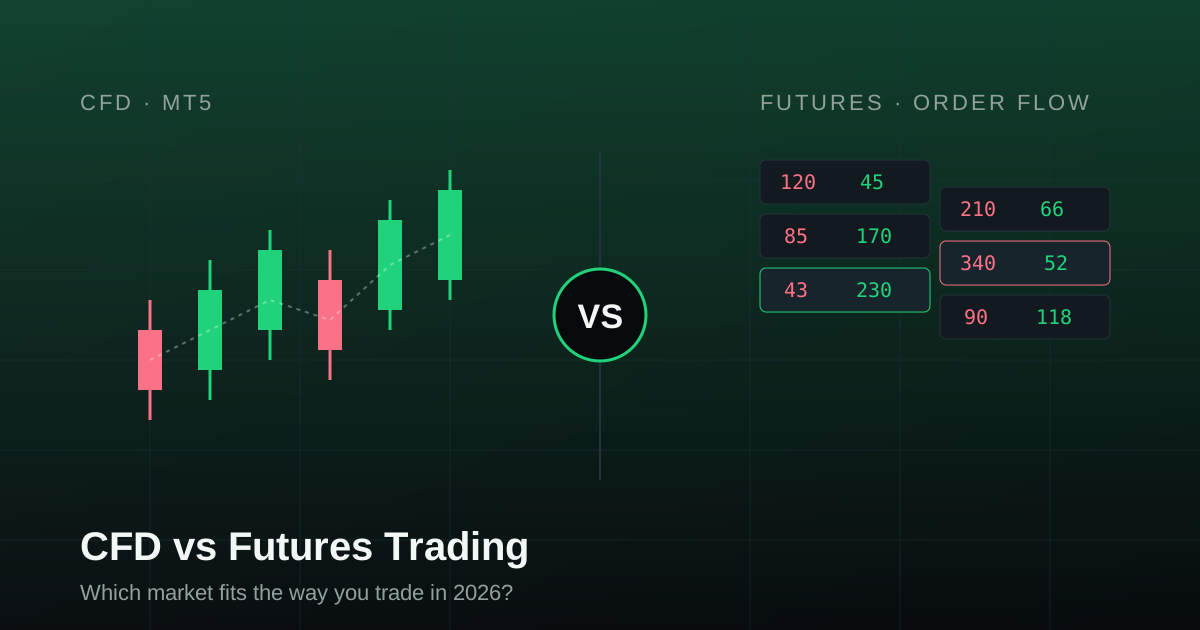
CFD vs Futures Trading: Which Market Is Better for Traders in 2026?
Some links on this page are affiliate links. We may earn a commission if you sign up through them, at no extra cost to you.
Ask ten traders whether CFDs or futures are better and you'll probably get ten different answers.
Some traders swear they'll never leave MetaTrader. Others claim they could never trade without footprint charts and order flow data.
The reality? Neither side is wrong.
CFDs and futures are simply two different ways of accessing financial markets. Both have produced consistently profitable traders, both have created full-time trading careers, and both have their own advantages and disadvantages.
The real question isn't "Which one is better?" It's "Which one fits the way you trade?"
CFD vs Futures: The Quick Answer
CFDs are generally easier to learn, require less technical setup, and are ideal for traders who focus on price action and multiple asset classes.
Futures offer centralized volume, exchange transparency, and access to institutional order flow tools.
Neither market is objectively better. They simply reward different styles of trading.
CFD vs Futures Comparison Table
| Feature | CFDs | Futures |
|---|---|---|
| Centralized exchange | ❌ | ✅ |
| Exchange volume data | ❌ | ✅ |
| Footprint charts | Limited | ✅ |
| DOM trading | ❌ | ✅ |
| MetaTrader support | ✅ | ❌ |
| TradingView integration | ✅ | Partial |
| Crypto markets | ✅ | Limited |
| Learning curve | Lower | Higher |
| Platform complexity | Low | Medium–High |
| Order flow analysis | Limited | Excellent |
| Exchange fees | ❌ | ✅ |
| Overnight financing | Yes | No |
| Position expiration | No | Yes |
What Is CFD Trading?
CFD stands for Contract For Difference. Rather than buying the underlying asset itself, traders speculate on price movements through a contract with their broker or prop firm.
If the market moves in your favour, you profit. If it moves against you, you lose money. Simple.
CFDs give traders access to a huge range of markets including:
- Gold (XAUUSD)
- Nasdaq indices (NAS100)
- Dow Jones (US30)
- Oil (USOIL)
- Forex pairs
- Cryptocurrencies
- Stock indices
For many retail traders, CFDs are where their trading journey begins. In fact, a huge percentage of retail prop traders spend almost all of their time trading just a handful of markets: XAUUSD, US30, NAS100 and EURUSD.
What Is Futures Trading?
Futures trading works differently. Instead of trading a contract with your broker, traders buy and sell standardized contracts listed on centralized exchanges.
Popular examples include:
- NQ (Nasdaq Futures)
- ES (S&P 500 Futures)
- CL (Crude Oil Futures)
- GC (Gold Futures)
- YM (Dow Futures)
These contracts trade on exchanges such as the CME. Because of that, all participants see the same centralized market activity. That's one of the biggest reasons many professional traders prefer futures.
The Biggest Difference: Centralized vs Decentralized Markets
This is probably the single most important difference between CFDs and futures.
CFDs Are Decentralized
When trading CFDs, your broker creates a synthetic version of the market. That doesn't mean the pricing is fake — in practice, prices track the underlying market extremely closely.
However, volume and order data are broker-specific rather than coming from one centralized exchange. This is why volume indicators often look slightly different between brokers.
Futures Are Centralized
Futures contracts trade on centralized exchanges. Every participant sees the same trades, the same volume, the same order book and the same liquidity.
This creates access to information that simply doesn't exist in CFD markets. For some traders that's a huge advantage. For others it makes very little difference.
Trading Gold: A Perfect Example
Imagine two traders want to trade gold. Trader one opens XAUUSD on MT5 through a CFD prop firm. Trader two opens GC Futures on NinjaTrader through a futures prop firm.
Both are trying to profit from exactly the same market movement. Gold rises, both make money. Gold falls, both lose money.
The difference isn't the market. The difference is the infrastructure behind the market.
Platforms: Where Things Start Looking Very Different
One of the easiest ways to tell CFD traders and futures traders apart is by looking at their screens.
CFD Trading Platforms
Most CFD traders use MetaTrader 4, MetaTrader 5, cTrader and TradingView. Clean charts, fast execution, simple workflows.
If your strategy revolves around price action, liquidity sweeps, market structure, support and resistance or supply and demand, MT5 is often more than enough.
Futures Trading Platforms
Futures traders tend to use a much wider range of software. Popular choices include:
- NinjaTrader
- Sierra Chart
- Bookmap
- ATAS
- Quantower
- Tradovate
- R Trader Pro
- MotiveWave
- Jigsaw Daytradr
- EdgeProX
- VolFix
- WealthCharts
At first glance these platforms often look overwhelming compared to MT5. That's because many futures traders rely heavily on additional market data.
Order Flow: The Feature That Changes Everything
If there is one topic that dominates futures trading discussions, it's order flow — analysing actual buying and selling activity inside the market.
Futures traders often use footprint charts, volume profiles, Time and Sales, heatmaps, DOM ladders and market depth. Platforms such as Bookmap and ATAS are built almost entirely around this type of analysis.
CFD traders often argue that price already reflects all of this information anyway. The debate has been going on for years and probably isn't ending anytime soon.
Why Many Traders Prefer CFDs
Simplicity. Getting started is easy — open MT5, open a chart, start trading.
Access to multiple markets. A single CFD account often covers forex, gold, indices, oil and crypto inside one platform.
Familiarity. Most retail traders learned on MT4 or MT5. Switching to futures platforms can feel like learning trading all over again.
Lower technical complexity. Most CFD traders don't need DOM ladders, footprint charts or order flow software. For many strategies, simple charts work perfectly well.
Why Many Traders Prefer Futures
Centralized volume. Every trader sees the same volume data.
Market transparency. One exchange, one order book, one source of truth.
Better order flow tools. Futures traders have access to some of the most advanced trading software in the industry.
A professional environment. Many traders feel futures markets operate closer to institutional trading environments. Whether that matters depends entirely on the trader.
Costs: Which Is Cheaper?
This question causes endless arguments online. The honest answer is: it depends.
CFD traders typically pay through spreads, commissions and overnight swap fees. Futures traders generally pay exchange fees, commissions, platform fees and market data subscriptions.
As a rough rule, scalpers and active intraday traders often find futures cheaper thanks to tight exchange spreads and transparent commissions. Swing traders holding positions for days or weeks may find CFDs more convenient, although overnight financing can add up over time. There isn't a universal winner.
Are CFDs Legal in the United States?
Retail CFD trading is prohibited for US residents. Because of that, most American retail traders who want leveraged market exposure trade futures instead.
This is one reason the futures industry became so dominant in the United States, while CFD trading dominates Europe, Asia and Australia.
Which Market Do Prop Firms Prefer?
Interestingly, the prop industry is heavily split between both markets.
CFD prop firms
Futures prop firms
The growth of both sectors suggests traders keep finding success in both. If you're leaning futures, our best futures prop firms roundup ranks the field on the drawdown model and price; on the CFD side, start with FTMO or FundingPips.
Sponsored
Want to trade CFDs with a proven firm?
FTMO helped define the modern prop model and has paid traders for years. Read our FTMO review, or head straight to their site.
Visit FTMOSo Which One Is Better?
The answer most traders hate hearing is: neither.
A trader who spends every day trading London-session breakouts on gold may never need anything more than MT5 and price action. A trader who scalps the Nasdaq using footprint charts may struggle to imagine trading without order flow. Neither trader is wrong — they're simply solving the same problem with different tools.
A good rule of thumb
CFDs might be a better fit if you:
- trade gold or forex regularly
- prefer simple charting platforms
- focus primarily on technical analysis
- switch between multiple markets quickly
- trade with MT5 or TradingView
Futures may be a better fit if you:
- trade exchange-listed products
- rely heavily on volume and order flow
- use DOM trading
- enjoy highly detailed market information
- prefer centralized exchanges
The best market is usually the one that feels natural to your strategy.
Final Thoughts
The CFD vs futures debate has existed for years and probably always will. The truth is that both markets offer incredible opportunities.
Some of the best traders in the world trade CFDs. Some of the best trade futures. The difference usually isn't the market — it's the trader behind the screen.
Understanding how both environments work simply gives you a better chance of finding the one that fits your personality, your strategy and the way you naturally see the market.
Frequently asked questions
Is futures trading harder than CFD trading?
Usually, yes. The software ecosystem is more complex and many futures traders use advanced tools such as footprint charts, DOM ladders and volume profiles.
Can you trade gold futures instead of XAUUSD?
Yes. GC futures and XAUUSD track gold prices very closely, although the market structure behind them differs significantly.
Do professional traders prefer futures?
Many institutional traders use futures because of centralized exchanges and transparent order flow. However, plenty of successful professional traders continue trading CFDs.
Is order flow possible on CFDs?
Not true exchange order flow. Because CFDs are decentralized, order book data is broker-specific rather than exchange-wide.
Is futures trading cheaper than CFDs?
For active scalpers, futures are often cheaper. For swing traders, CFDs can sometimes be more convenient despite overnight financing costs.
Keep reading
Risk note